Every Child Deserves a Board That Asks the Hard Questions
The Gaps No One Has Adequately Explained
Look closely at our district's own data and you will find something that should be impossible to ignore. Within the same school, with the same teachers, using the same curriculum, some students are thriving and others are not. And the pattern is not random.
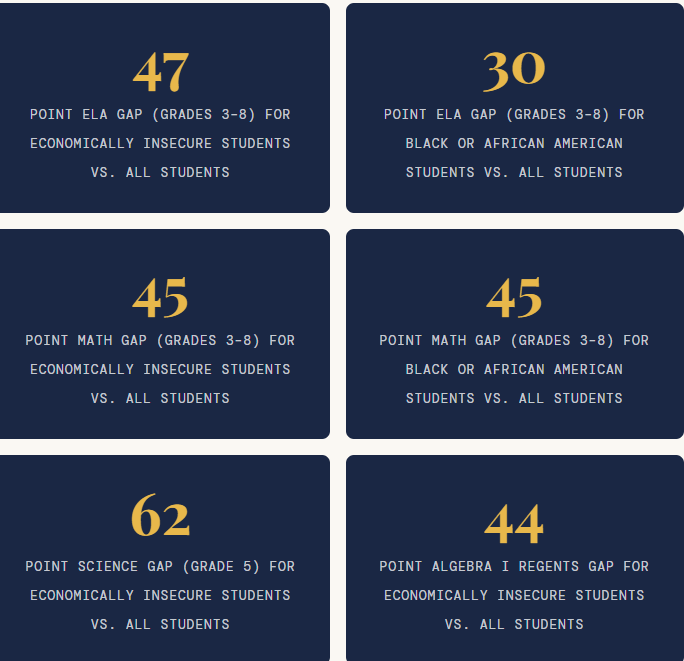
Comprehensive State of the District Report, 2024-2025 School Year
These gaps appear and map with depressing consistency onto race and income. The ELA gap for economically insecure students across grades 3 through 8 is 47 points. The math gap is 45 points. They are a pattern, present across subjects, across grades, and across years. And the District has yet to provid acceptable answers to explain them.
What the Science Says Our Children Need
On May 2nd, I attended researchED NYC, a conference that brought researchers and educators from seventeen states, Puerto Rico, and at least four countries to discuss the science of learning. The keynote, titled "Using the Science of Learning to Rebuild Students' Learning Power: A Pathway to Equitable Academic Outcomes," was delivered by Zaretta Hammond, author of Culturally Responsive Teaching and the Brain. It was one of the most informative and energizing hours I’ve spent in a long time.
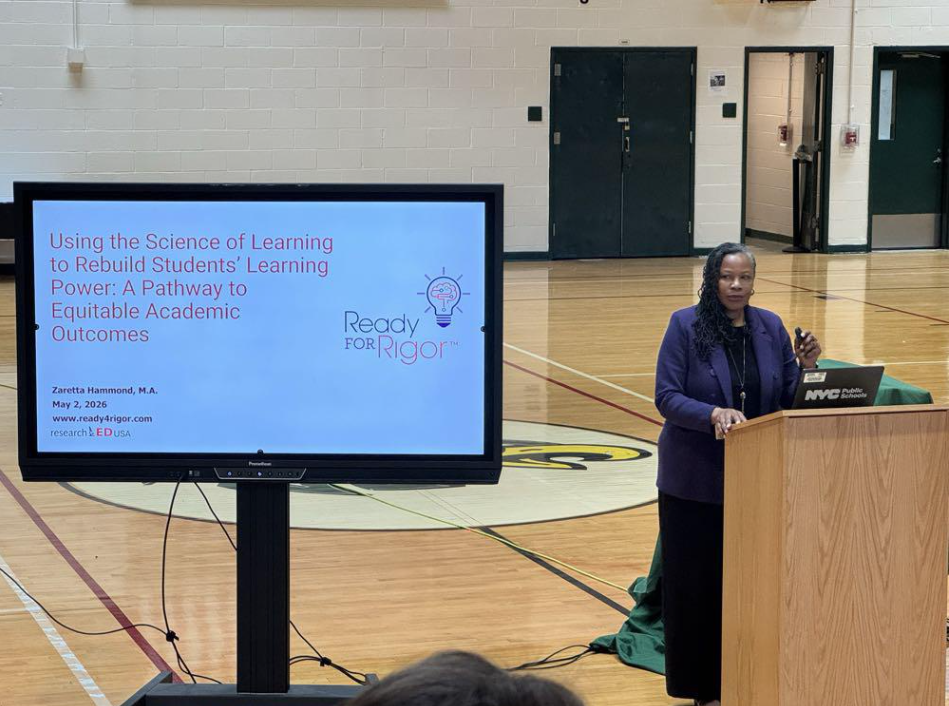
"The goal is cultivating the unique gifts and talents of every student, regardless of color, language, or zip code."
Zaretta Hammond, researchED NYC 2026
Cognitive Redlining: A Racial Equity Problem
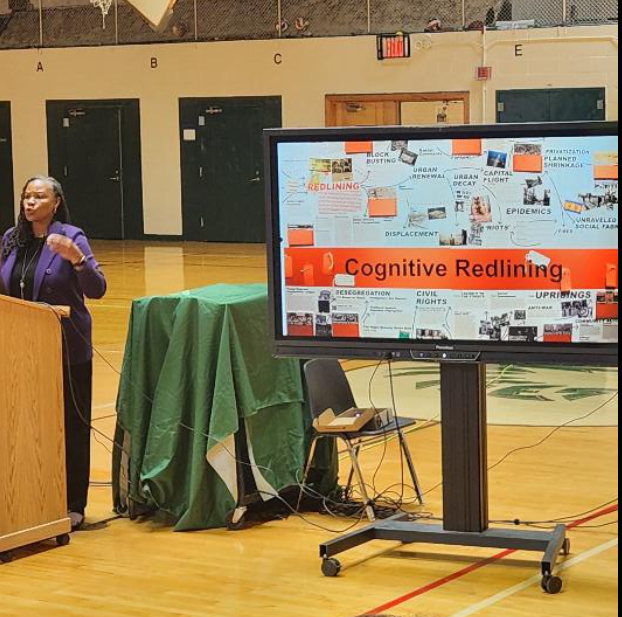
The term Hammond used that hit hardest was "cognitive redlining." Most people know the history of housing redlining: systematically denying investment to communities of color across generations. Schools can do something structurally similar, albeit unintentionally. Students who most need powerful, rigorous, knowledge-rich instruction are systematically denied access to it when curricular and instructional decisions are not supported by the evidence about how children learn. The predictability of who succeeds and who fails is a design flaw.
Some people look at these gaps and see deficits in the children. I look at the same data and see deficits in instruction. A child who arrives at school without the academic foundation their more privileged peers have is not less capable. What they lack is not potential or ability. What they lack is the private safety net that cushions wealthier children from the damage of weak instruction. Families with greater resources can compensate with tutors, enrichment programs, and the time and bandwidth to fill the gaps school leaves behind. When we attribute the gap to the child or the family, rather than to what the school failed to provide, we let the system off the hook. And when our Board has no structure to ask whether the instruction is working, the system stays off the hook indefinitely.
What Hastings Has Actually Been Doing
Our District’s test score data gives us a concrete, documented example of what happens when a Board fails to exercise proper oversight and allows a district to adopt curriculum and professional development without verifying the Administration's claims about its grounding in evidence and research.
In 2017, the Board approved the Administration’s proposal to hire Gravity Goldberg LLC to develop our K-4 literacy curriculum and professional development over a five-year period, at the cost of over $250,000.
The Administration told the Board, and the public, the work they would be doing with Gravity Goldberg under the proposed contracts was grounded in research. At the time, and in the years since, numerous parents questioned the existence and validity of this research, and whether the ELA curriculum was meeting the needs of students, particularly those most at risk. The Board’s response wasn’t to question and scrutinize the Administration’s proposals, it was to do what the Superintendents at the time asked: they approve the contract funding, every time. Board members who tried to raise concerns were even told by other members that it was not their role to question what the Superintendent asked for.
Now, despite this significant investment of taxpayers’ dollars, and faculty time and energy, Hastings continues to have severe proficiency gaps across racial and economic lines. The ELA proficiency gap between African-American and white students in Hastings is wider than the gap between the same groups state-wide.
In 2025, after NY required all districts to submit an attestation certifying that their K-3 ELA curriculum meets NY’s evidence and research based instructional standards, a problem emerged. The Administration realized it needed to hire a different consultant to audit the curriculum Gravity Goldberg had helped create. The Board approved the contract for a second consultant, without asking the obvious question: if this curriculum was evidence and research based as we were told, why do we need to pay someone else to audit it before we can certify it to the state?
While the District should always engage in self-assessment and critique, it is important to remember that this audit was not the result of the Administration or the Board responding to years of parents’ concerns, but the result of a state mandate. The audit was performed, the attestation was submitted, but the audit results have never been presented to the Board. In October 2025, after the audit was concluded, just eight years after the District launched the five-year Gravity Goldberg plan, the Administration informed the Board it would "design a new literacy plan for the next 3-5 years."
Why We Cannot Fix Academic Inequity Unless We Fix How the Board Governs
Our Board currently has three committees: Audit/Finance, Facilities, and Policy. There is no Curriculum and Instruction committee, no Board-level structure for asking the Administration the questions Hammond would have us ask: Is our curriculum grounded in how the brain actually learns? Are we providing instruction that builds learning power for every student? Are the children who have historically been underserved getting the cognitive investment they deserve? Are we looking at the right data to understand whether our test scores and other outcomes are the result of our curriculm and instruction, or outside confounding factors?
Under New York law, the Board has a legal obligation to oversee and approve curriculum. It is not fulfilling that obligation. The Gravity Goldberg story is what that failure looks like in practice: a curriculum adopted without rigorous Board-level scrutiny, a critical vendor relationship that grew without transparent oversight, and a Board that approved spending without accountability.
The predictability of who succeeds and who fails in this district is a design flaw, not an inevitability. Fixing it requires a governance structure that can see the problem, name it, and hold those responsible accountable for changing it. Right now, ours cannot.
What I Am Running to Change
1. Restore the Board's oversight and approval authority for curriculum and instruction
2. Create a Curriculum and Instruction committee at the Board level, to scrutinize and ensure whether what and how we are teaching is grounded in evidence and working for as many children as possible
3. Require that any curriculum adopted is supported by an independent evidence base, and there is a plan developed in advance to assess and validate the efficacy of any internally developed curriculum
4. Require that the data presentations disaggregate results by student subgroup and account for confounding variables before drawing conclusions about instructional effectiveness
5. Require transparent, publicly posted minutes of all committee meetings so the community can follow the Board's work
